

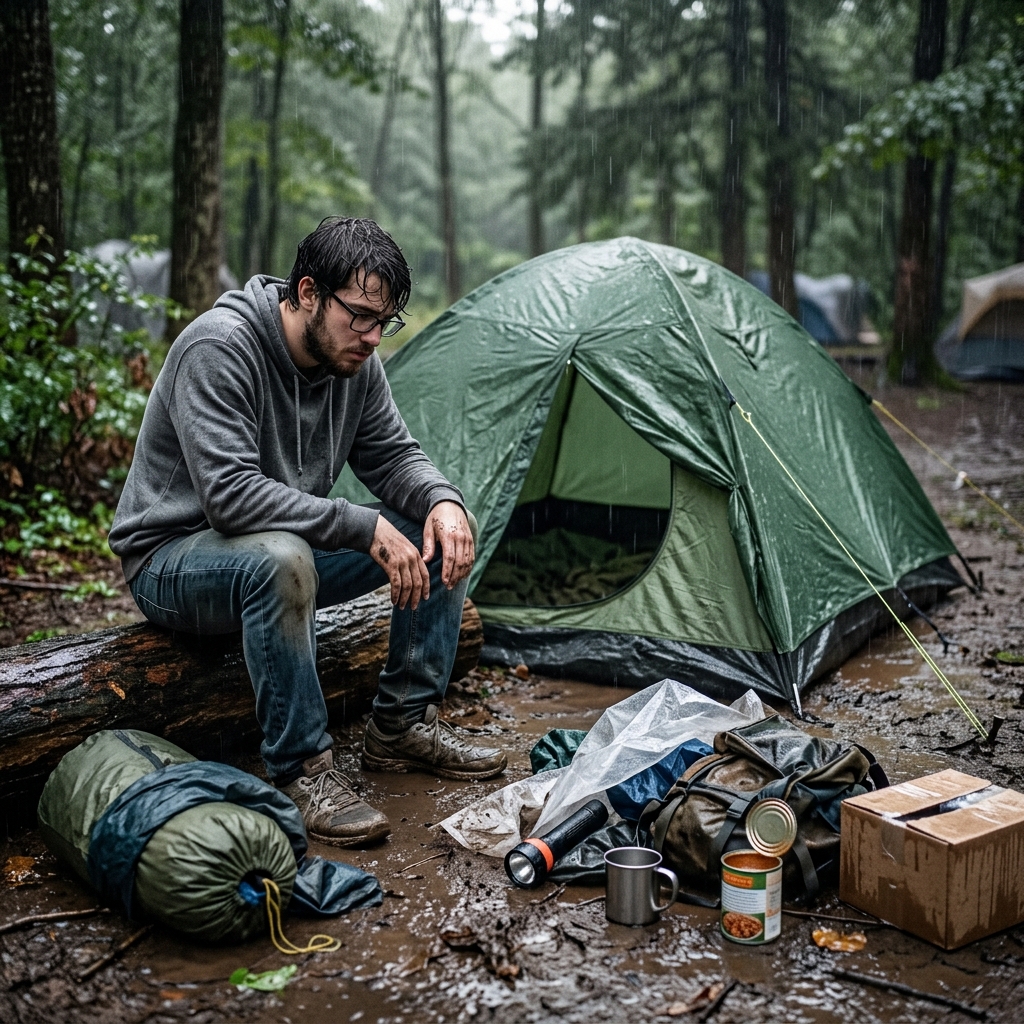
Most camping mistakes follow recognizable patterns. The same five errors show up on first and second trips so consistently that they're almost a rite of passage. Knowing them in advance doesn't guarantee you'll avoid them — but it increases the odds significantly.
Mistake 1: Arriving After Dark
This is the most common, most preventable, and most impactful mistake beginners make.
Setting up camp after dark takes three to four times longer than in daylight. A tent you could pitch in 10 minutes by the light of a late afternoon sun takes 40 minutes with a headlamp, with shadows in the wrong places, with stakes going into ground you can't see properly. Everything is harder — identifying the flattest ground, stringing a tarp, finding the one stake you dropped.
The fix: Arrive with 2–3 hours of daylight remaining. If you can't make that window, adjust your departure time or choose departure day carefully. The amount of friction this single habit change removes from camping is disproportionately large.
Mistake 2: An Under-Rated Sleeping Bag
More first-time campers have a miserable cold night than any other single bad experience. The cause is almost always a sleeping bag used at or above its rated temperature.
The temperature rating on a sleeping bag reflects the lowest temperature at which a standardized average sleeper (often a male) stays minimally comfortable — not warm, minimally comfortable. Cold sleepers, lightweight people, or anyone who runs cold should add at least 10–15°F of margin.
A bag rated to 40°F used on a 40°F night will often produce a cold, miserable experience. A bag rated to 25°F used on a 40°F night is comfortable, and you can always vent it if you're warm.
The fix: Buy a bag rated 10–15°F colder than the coldest night you expect. Read about how sleeping bag temperature ratings actually work before you buy.
Also: don't forget the sleeping pad. The pad's R-value is as important as the bag's temperature rating — the ground steals heat faster than cold air.
Mistake 3: No Tent Practice
Tent manufacturers write instructions that are logical once you've assembled the tent before. They're baffling when you're seeing the poles and clips for the first time at 8pm in a parking lot.
The fix is embarrassingly simple: set your tent up once in your backyard before the trip. Just once. In daylight. Without the pressure of a camping group waiting for shelter. This eliminates tent setup difficulties almost entirely. You'll also discover any missing stakes, broken pole segments, or missing stuff sacks while you can still replace them.
The fix: Every new tent. Before every camping season if there's been a gap. 15 minutes of home practice removes all tent setup stress from your camping trips.
Mistake 4: Cotton Clothing
"Cotton kills" is outdoor hyperbole that contains a non-hyperbolic truth: cotton absorbs moisture, stays wet, and loses its insulating properties completely when saturated.
In mild conditions this is annoying — you feel cold and damp when everyone else in synthetic or wool is comfortable. In genuinely cold or wet conditions, being soaked in cotton is dangerous. Hypothermia doesn't require freezing temperatures; it requires cold + wet + wind.
Most beginners pack cotton because that's what's in their closet. Jeans, cotton t-shirts, cotton hoodies. These are fine clothing choices at home. They're poor choices for sustained outdoor activity.
The fix: Moisture-wicking base layers (synthetic or merino wool), a mid-layer (fleece or synthetic puffy), and a waterproof outer layer. No cotton except as camp-only layers that stay dry. The AATW gear guide covers the full layering system.
Mistake 5: Overplanning the Itinerary
First-time campers often plan their camping trip the same way they'd plan a vacation itinerary: scheduled activities, set departure times, meals planned to the minute.
Then a campfire goes longer than expected. Or someone wants to nap in the afternoon. Or the lake is better than the hike looked on paper. And the rigid schedule creates friction because the whole point of camping — being outside without the usual structure — is in direct conflict with maintaining a structure.
Over-itineraried camping trips consistently report lower satisfaction than loosely-structured ones, even when the actual activities are equivalent.
The fix: Plan meals (these require logistics) and one or two anchors (a specific hike, a sunrise) and leave the rest open. Accept that camping runs on a different time. The best moments on camping trips are almost never the ones that were scheduled.
None of these mistakes are serious. They're all learnable and most people only make them once. The goal isn't to camp perfectly — it's to camp enough times that you stop making the beginner mistakes and start making the experienced-camper mistakes, which are at least more interesting.