

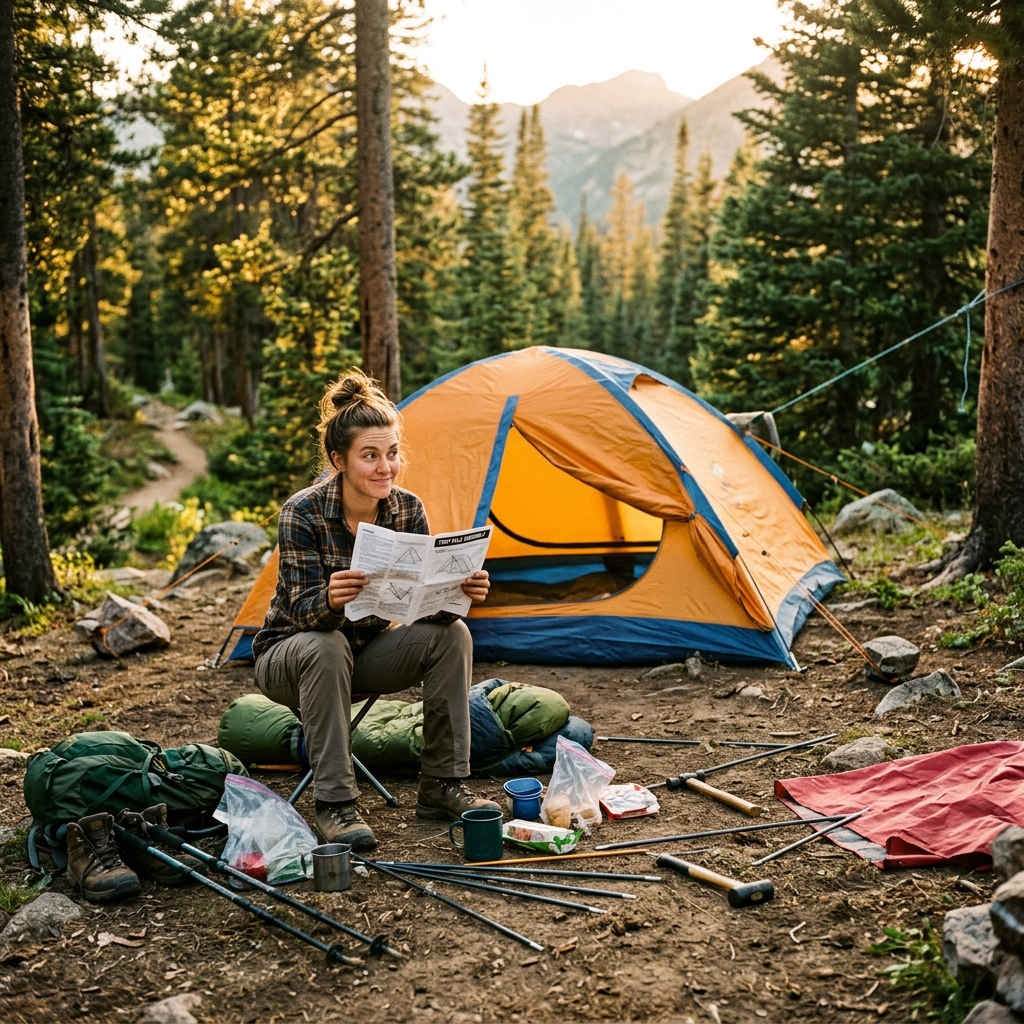
Here is an almost universal truth about first camping trips: something will go wrong.
The tent stakes won't be in the bag. The stove will need a lighter you left in the car. You'll arrive later than planned, set up in fading light, and wonder if the ground slope was really this bad when you looked at it in daylight. At some point you'll realize you forgot something — it might be trivial, it might be moderately annoying, but it will be something.
And this is fine. This is, in fact, correct.
The First Trip is a Data Collection Exercise
Here's the frame shift that makes the first trip significantly less frustrating: treat it as a learning exercise, not a performance.
You are not trying to have the perfect outdoor experience. You are building a baseline. You are learning what you actually need versus what the internet told you to bring. You are discovering your personal failure modes under low-stakes conditions.
The camper who loses a tent stake at a developed campground with a camp store down the road learns something valuable before they're 10 miles into the backcountry. The person who doesn't know their stove igniter corrodes when unused learns it on a weekend trip, not at 11,000 feet.
Every mistake on trip one is a free education you didn't have to pay for.
The Most Common First-Trip Failures (And What They Teach)
"I forgot [item]." What it teaches: Your packing system needs work. After this trip, you'll make a checklist. The third trip, you won't need to think about it at all. The checklist problem solves itself, but only if you take the first trip and discover what you forgot.
"The tent was harder to pitch than I expected." What it teaches: Practice at home first. Every tent, every time, before the trip. Fifteen minutes of daytime backyard practice eliminates all of this. One trip's worth of tent fumbling and you never fumble again.
"I was cold at night." What it teaches: The number on your sleeping bag is not the whole picture. You need a pad underneath (the ground conducts cold faster than air). You need to sleep in layers. You probably went with a bag rated right at the temperature — go 10–15°F colder next time. Cold sleeping is almost entirely a solvable equipment problem.
"The food wasn't great." What it teaches: Camp cooking takes iterations, not talent. The first trip you're figuring out the stove and sequencing the meal. By trip three, you're actually cooking food you're genuinely excited about.
"I was anxious the first night." What it teaches: New environments trigger alertness. Every unfamiliar sound registers as a potential threat — this is your nervous system running a threat assessment that evolved over tens of thousands of years. It will pass. By 10pm you'll be used to it. By night two it's barely present. This isn't a problem to solve; it's an experience to move through.
The Gear Problem is Overstated
Before the first trip, most people spend significant time worrying about gear. Researching tents, comparing sleeping bag ratings, reading forum threads about the best camp stove. This is useful to a point.
After the first trip, you'll know more about what you need than any amount of pre-trip research. Because you'll have learned which of your gear choices were wrong, which were right, and which you never touched.
The first trip reveals what you actually use. That information can't be acquired any other way.
What "Going Wrong" Usually Looks Like
The failures people worry about (bear attack, getting hopelessly lost, dangerous weather) are vanishingly rare on a first camping trip at a developed campground.
The failures that actually happen are logistical and mild: a forgotten item, an awkward setup, a cold night, a meal that underwhelmed. These are inconveniences, not emergencies. They are problems that teach things.
The campers who have the worst first trips are the ones who take the inevitable imperfection as evidence that outdoor life isn't for them. It isn't evidence of that. It's evidence that they're at the beginning of a learning curve that everyone who camps regularly has been on.
The Second Trip
Every experienced camper I've encountered has the same memory of their second outdoor trip: it was noticeably better. The lessons from the first trip quietly applied themselves. The tent went up smoother. The food was better. The night sounds were familiar. The anxiety was mostly gone.
The second trip isn't perfect either. But it's better. And the third is better than the second. This is how competence accumulates — through iterations, not through watching videos of other people doing it correctly.
The only camping trip that doesn't teach you anything is the one you don't take.
Your first trip almost certainly won't go perfectly. Go anyway. Take notes. The thing you forget this weekend is the thing you'll never forget again.
When you're ready to plan your next trip — and there will be one — use AATW's Explore Map to find your site and the Trip Planner to coordinate with friends.