

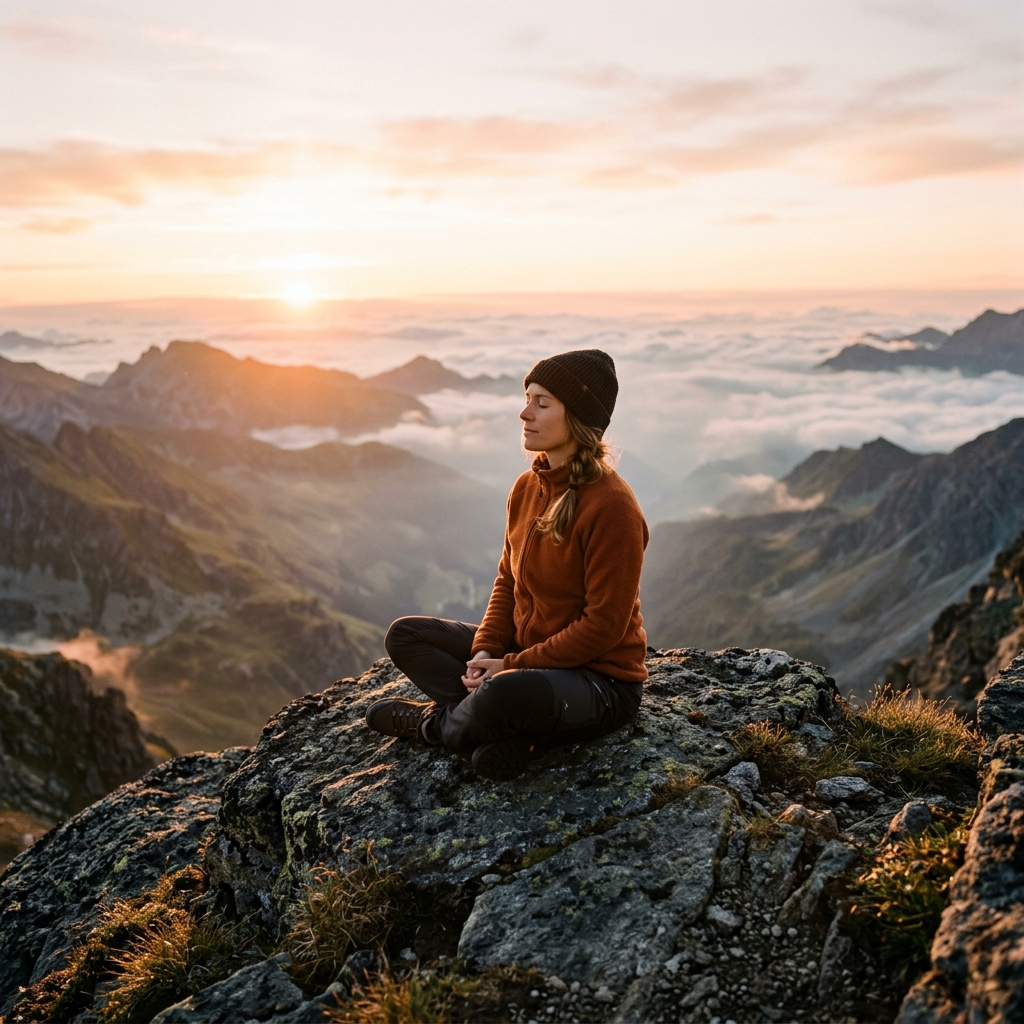
Most people who camp regularly can tell you it makes them feel better. Clearer. Less wound up. More present. Less anxious about the things they were anxious about on Friday morning before they left.
What they can't always tell you is why. The "why" turns out to be specific, well-studied, and more interesting than the generic "being in nature is good for you" framing that gets applied to it.
Here's what's actually happening.
Directed Attention Fatigue — and Its Antidote
Cognitive neuroscientists use the term "directed attention fatigue" (DAF) to describe a specific kind of mental depletion. Directed attention is the effort to consciously focus — to concentrate on a spreadsheet, a meeting, a conversation thread, a deadline. It requires active suppression of competing stimuli.
Modern environments are dense with things competing for directed attention. Notifications, traffic, screens, crowded spaces. The prefrontal cortex — the region most associated with executive function and directed attention — works continuously and doesn't stop until you give it a reason to.
Attention Restoration Theory (ART), developed by Rachel and Stephen Kaplan at the University of Michigan, proposes that natural environments restore this depleted capacity. The key mechanism: nature is intrinsically interesting without demanding directed attention. Looking at moving water, watching trees in wind, or listening to bird calls engages what the Kaplans called "soft fascination" — involuntary attention that doesn't require mental effort. The prefrontal systems that handle directed attention get a rest.
The research behind ART has been replicated across many contexts. A notable 2012 study in Psychological Science (Atchley et al.) found that backpackers scored 50% higher on creative problem-solving tasks after four days in the wilderness — the effect attributed to reduced directed attention demands and increased undirected processing.
Cortisol and Time in Green Space
Cortisol is the primary stress hormone. In an acute stress response it's useful — it mobilizes energy and heightens alertness. In chronically elevated states (urban environments, demanding jobs, always-on information environments), sustained cortisol is associated with impaired memory, immune suppression, and increased anxiety and depression rates.
Multiple studies have measured cortisol before and after time in natural environments, both controlled and uncontrolled. The consistent finding: cortisol drops in natural environments, and the effect is significant.
A widely cited 2010 study by Bratman et al. found measurable cortisol reduction in subjects who walked in natural settings compared to urban settings — and that the effect held even when controlling for exercise. The nature exposure itself was the variable.
Japanese researchers have studied shinrin-yoku ("forest bathing") extensively, finding that time in forested environments reduces cortisol, lowers blood pressure, slows heart rate, and increases Natural Killer cell activity (a marker of immune function). These are not small effects — the NK cell improvements in some studies persisted for a week following exposure.
The Awe Effect
Psychologists Jonathan Haidt and Dacher Keltner have spent two decades studying the emotion of awe — the response to encountering something vast enough to challenge your current mental structures. Mountains, night skies, old-growth forests, grand canyons.
Awe appears to be uniquely valuable among emotions. Studies consistently find that awe experiences:
- Reduce self-referential thinking (the mental chatter about your own concerns)
- Increase pro-social behavior and sense of connection to others
- Reduce inflammatory cytokine levels (biological markers of chronic stress)
- Expand the perceived sense of time — people under the influence of awe experience time as slowing down
In a 2015 study in Psychological Science, subjects who experienced awe rated themselves as having more time, expressed more patience and willingness to help others, and reported higher life satisfaction compared to control groups — even accounting for overall positive mood states.
Camping, hiking, and outdoor exposure are among the most reliable triggers for awe in ordinary life.
Default Mode Network Deactivation
The "default mode network" (DMN) is a set of brain regions that activate when we're not focused on the external world — during mind-wandering, self-referential thought, and rumination. In people with anxiety and depression, the DMN is often overactive, constantly running loops of self-focused worry.
Demanding physical environments in nature — technical trails, unfamiliar terrain, dynamic weather conditions — naturally suppress DMN activity by requiring sustained environmental focus. You can't ruminate effectively while navigating a boulder field in the rain.
Extended outdoor exposure also shifts the DMN toward "positive constructive daydreaming" — the kind of relaxed, wandering thought associated with insight and creative connection-making — away from the repetitive negative loops typical of urban-environment DMN activity.
Sleep Architecture
Camping normalizes the circadian rhythm. Exposure to natural light patterns — bright daylight in the morning, declining light in the afternoon, darkness after sunset — resets the biological clock more effectively than any artificial intervention.
A 2013 study by Wright et al. published in Current Biology measured the melatonin cycles of subjects before and after a week of camping without artificial light. The result: melatonin onset shifted two hours earlier, aligning closer to natural sunset. Subjects reported easier sleep onset and waking. The effect was measurable after a single weekend of camping.
Blue-light exposure from screens suppresses melatonin production and delays sleep onset. Camping simply removes this entirely.
The Practical Upshot
You don't need to know the mechanism to benefit from it. But knowing the mechanism is useful because it answers the question "is this actually doing something or am I just convincing myself it is?"
It's doing something. The mechanisms are specific and physiologically real. Time outdoors reduces stress hormones, restores depleted attention, creates optimal conditions for deep sleep, suppresses ruminative loops, and generates the emotion most associated with expanded wellbeing and reduced self-absorption.
The forest isn't magic. It's just a particularly well-designed environment for a brain that spent most of its evolutionary history in one.
Plan your next time outside on AATW's Explore Map. Your prefrontal cortex will appreciate it.