

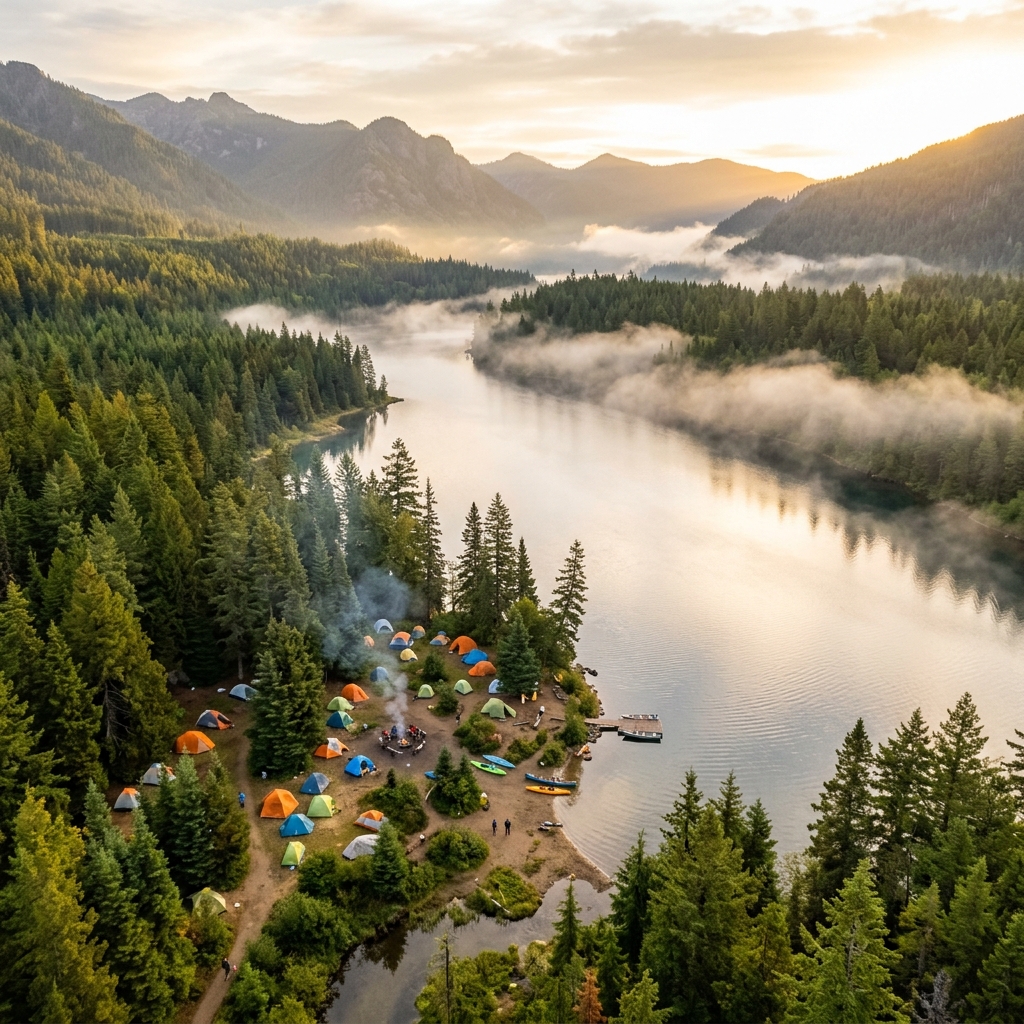
The campsite you choose shapes the entire trip. A bad site — wrong exposure, poor drainage, too close to neighbors, too far from water — compounds into hours of discomfort. A good site makes everything else easier.
This guide covers finding and booking sites through official channels, evaluating a site on arrival, and the nuances of both developed and dispersed camping.
Types of Camping: The Spectrum
Understanding what type of camping you're looking for is the first step to finding the right site.
Developed Campgrounds Designated sites with infrastructure: numbered pads, fire rings, parking spots, bathrooms, and often water. These are bookable in advance and are the entry point for most campers. Land managers: National Park Service, US Forest Service, Bureau of Land Management, state park systems.
Dispersed Camping On most National Forest land and much BLM land, free camping is permitted anywhere outside of designated campgrounds, provided you follow distance rules (typically 100–200 feet from water sources, trails, and roads). No facilities, no fee, no reservation. Requires more navigation competence and self-sufficiency.
Primitive Campsites Some land managers maintain primitive campsites — designated spots with no amenities but a specific location. Often accessible by dirt road. Sometimes require a permit. The middle ground between developed and dispersed.
Finding Campsites: Where to Look
Recreation.gov The federal booking platform for National Parks, National Forests, BLM lands, and other federal sites. Six-month rolling booking window for most sites. Popular sites (Yosemite Valley, Grand Canyon North Rim, etc.) book within minutes of availability opening. Set up an account in advance and use notification alerts.
ReserveAmerica / Reserve California / Reserve America State park booking varies by state. Most state park systems have their own portals. Search your specific state's parks department website.
AATW's Explore Map AATW aggregates location data from RIDB, OpenStreetMap, and other sources into a searchable map of over 45,000 outdoor locations. Use the Explore Map to discover campgrounds near a destination and see nearby amenities, elevation, and terrain context. From there, link through to the booking platform.
Campendium, The Dyrt, Freecampsites.net User-generated review platforms that surface campground options not always visible in official search. Particularly useful for finding dispersed camping spots on BLM land and detailed reviews of developed sites.
Booking Strategy: Getting the Sites You Want
Book exactly at the booking window open. For Recreation.gov, this is typically 6 months in advance to the day, at midnight Pacific time. Popular sites at National Parks are gone within seconds of becoming available. Set an alarm.
Have flexible dates. Weekday nights (Monday–Thursday) at most campgrounds are significantly less competitive than weekends. If your schedule allows, this is often the easiest path to getting first-choice sites.
Have backup options prepared. When booking, have your first, second, and third choices ready simultaneously. If your first choice is gone when you hit submit, pivot immediately.
Consider walk-up sites. Many campgrounds hold a percentage of sites for walk-in day-of availability. Showing up at check-in time (typically 2–4pm) gives you a chance at last-minute cancellations.
How to Evaluate a Campsite Before Committing
Whether you're choosing between reserved sites or selecting a dispersed site, evaluate these factors:
Drainage: Look at the site's grade. Does it slope toward any area where you'd be sleeping? Even a slight depression accumulates water in rain. Choose sites with gentle drainage away from the sleeping area or flat ground above any potential water flow.
Ground cover: Remove any sticks, rocks, or pinecones from sleeping areas. Identify any roots or rocks that would be uncomfortable under a pad. The clearest, most uniform ground is usually the best tent placement.
Sun and shade exposure: Morning sun hits east-facing sites first — useful if you want early warmth. Afternoon shade is critical in hot climates. Dense tree canopy stays cooler but may drip for hours after rain stops.
Wind: Elevated exposed sites get wind (usually a feature, not a bug — better ventilation and fewer bugs). Valley and canyon floors funnel and accelerate wind. Consider your tent's weatherproofing relative to expected conditions.
Distance from water sources: For bearing in mind Leave No Trace, camp at least 200 feet from lakes, rivers, and streams. But proximity matters for water access throughout your stay — a site 300 feet from a clean water source is preferable to one half a mile away.
Widow makers: Look up. Dead branches or leaning dead trees ("widow makers") directly above a tent site are a genuine hazard in wind events. Don't camp under them.
Privacy and neighbor proximity: At a campground, different sites offer different buffer from neighbors. Corner sites, end-of-loop sites, and sites separated by vegetation provide more privacy. Check the campground map and satellite imagery before booking.
Dispersed Camping: Rules That Actually Matter
Dispersed camping on public land operates under Leave No Trace principles and legally enforceable distance rules. The commonly applicable rules on National Forest and BLM land:
- Camp at least 100–200 feet from water sources (lakes, streams, rivers) — the exact distance varies by Forest or BLM district; 200 feet is a conservative rule that applies everywhere
- Camp at least 100 feet from any established trail
- Don't camp in the same spot for more than 14 days (14-day limit on most public land)
- No campfires in fire restriction areas — check current restrictions before every trip
- Pack out all trash — there are no trash facilities
Finding dispersed sites: OnX Maps, CalTopo, and Gaia GPS all show land ownership layers, making it easy to identify National Forest (green) vs. private (white or gray) land. Areas marked "Wilderness" within National Forests may have additional restrictions on group size and camping locations.
Campsite Red Flags
These are sites to avoid regardless of availability:
- Previous fire rings built directly on bare ground — poorly executed prior camping; follow established behavior only where designated
- Compacted soil with very little vegetation — indicates heavy use, poor drainage
- Obvious evidence of bear activity (torn logs, scat, claw marks) — not a disqualifier necessarily, but worth noting for food storage vigilance
- Areas with dry, tall grass — fire risk; choose sites on mineral soil or rock when possible during dry conditions
- Directly below a cliff or steep slope — rockfall and debris risk
Campsite Setup Best Practices
Once you've selected your site:
- Place the tent first — the best flat ground area goes to sleeping, everything else fits around it
- Establish a kitchen downwind — cooking smells should blow away from the sleeping area, not through it
- Identify your food storage solution before unpacking food — bear box, car, or bear canister location
- Walk the site perimeter — note any hazards, identify where you'll filter water, plan your waste management
The time spent choosing and evaluating a site pays dividends throughout the trip. A well-chosen campsite is one you stop thinking about — it just works. That's the goal.
Use AATW's Explore Map to discover campgrounds across the US, read location details, and plan your trip before you go.