

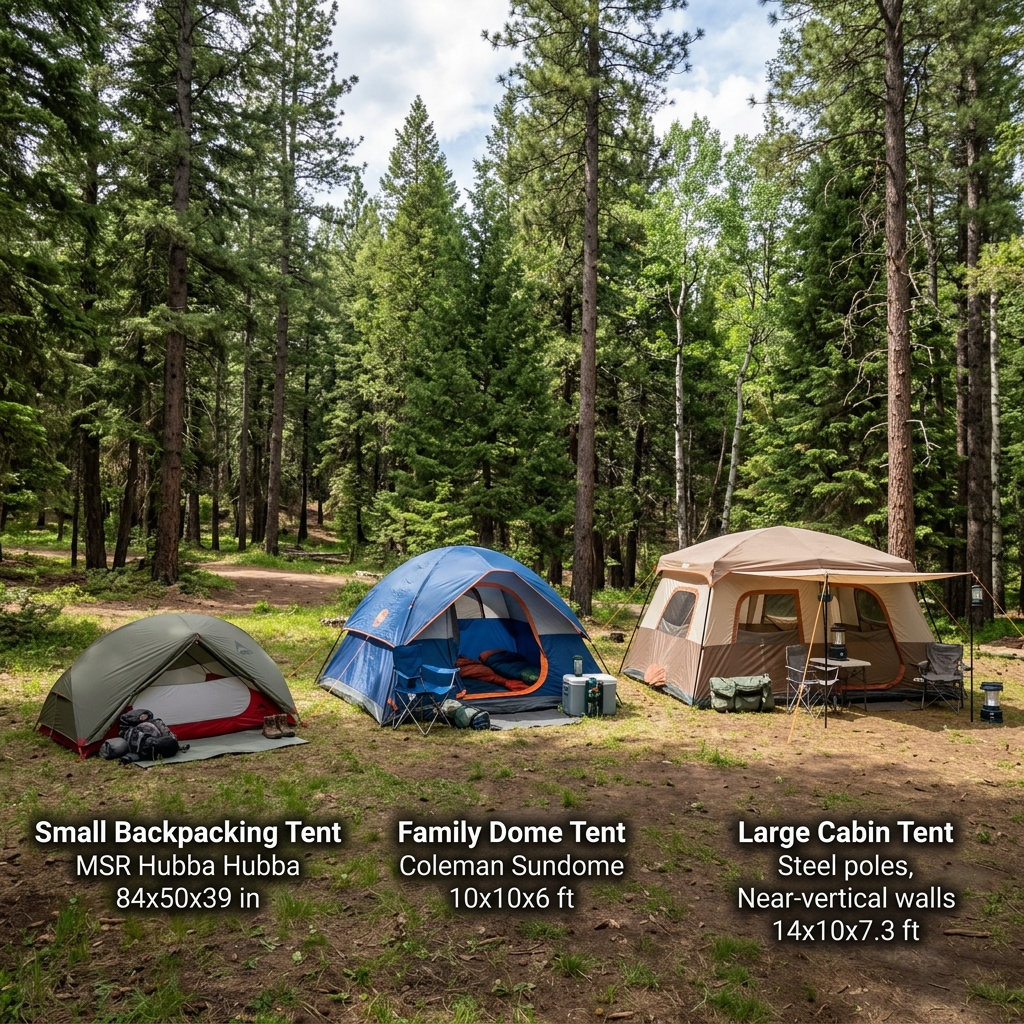
A tent is your home in the outdoors. Get it wrong and you spend nights damp, cramped, or fighting the structure every time you set it up. Get it right, and it disappears — you stop thinking about it and just use it.
This guide explains every significant aspect of tent selection: what the season ratings actually mean, why capacity labels are misleading, how poles work, what drives price differences, and how to match a tent to the specific camping you'll actually do.
Step 1: Define How You're Using It
Before looking at any tent, answer these questions:
- Car camping or backpacking? Car camping allows unlimited weight and size. Backpacking demands light weight and small pack size.
- Solo, couple, or group? Determines capacity.
- What season and climate? Summer only, or shoulder seasons with rain and wind?
- How often? A once-a-year camper can buy differently than someone going out 20 nights per season.
Season Ratings: What They Mean in Practice
3-Season Tents Designed for spring, summer, and fall conditions: rain, moderate wind, and temperatures above freezing. The mesh panels that make 3-season tents breathable and light sacrifice some insulation and wind resistance. These are the right choice for the vast majority of campers.
4-Season (Winter) Tents Designed for sustained snow loading, strong winds, and freezing temperatures. Sturdier pole geometry (more poles, crossing at different angles) distributes snow load. Denser fabrics retain more heat. Significantly heavier and more expensive than 3-season tents. Appropriate for mountaineering, winter camping, and alpine basecamp situations — not for car camping in cold-but-not-winter conditions.
Extended-Season (3+ or 3–4 Season) Some manufacturers label tents as "3-season plus" or "3–4 season." These typically use slightly sturdier construction than true 3-season tents but less than full 4-season designs. Appropriate for early spring, late fall shoulder season camping where you might encounter below-freezing temps but not sustained snow loads.
Capacity: The Actual Usable Space
The industry convention around tent capacity is one of outdoor retail's most persistent misleading practices.
| Stated Capacity | Actual Comfortable Occupancy |
|---|---|
| 1-person | 1 person (no gear inside) |
| 2-person | 1 generous adult, or 2 adults with nothing else |
| 3-person | 2 adults with some gear |
| 4-person | 2 adults with full gear, or 3 adults tight |
| 6-person | 4 adults comfortably |
The general rule: buy one size larger than you think you need. The weight penalty for a 3-person vs. a 2-person tent in car camping is irrelevant. In backpacking, you accept the trade-off consciously.
Livability features that actually matter:
- Peak height: Lower than 36" means hunched movement; 48"+ means you can sit comfortably
- Floor area: 30+ sq ft per person for comfort
- Vestibules: Covered outdoor areas outside the door — essential for storing muddy boots and wet gear without bringing it inside
- Two doors: Critical if sharing a tent — otherwise one person climbs over the other at 3am
Pole Systems
Aluminum Poles Standard on mid-range to high-end tents. Aluminum is strong relative to weight and can be repaired in the field with a pole sleeve. Bends rather than shattering under stress.
Fiberglass Poles Common on budget-tier tents. Heavier than aluminum and can splinter and shatter under stress (cold weather makes this worse). Adequate for occasional fair-weather camping; not ideal for demanding conditions.
Carbon Fiber Poles Used in ultralight backpacking tents. Extremely light and stiff, but brittle — will shatter rather than bend. Expensive and hard to repair in the field. For experienced ultralight backpackers only.
DAC Poles DAC (Dongah Aluminum Corporation) is a South Korean manufacturer that produces the aluminum poles used in most premium tents. If a tent spec sheet mentions DAC poles, that's a quality indicator.
Pole configuration: Single-pole tunnel tents set up fast and shed wind well but require proper staking. Dome tents with crossing poles are freestanding and more intuitive for beginners. Geodesic designs with multiple crossing poles are the strongest in high wind but heaviest.
Rain Fly Coverage: The Critical Factor
A rain fly is the outer layer that sheds rain. Its coverage determines how weather-worthy the tent actually is.
Full-coverage fly: Extends close to the ground on all sides. Best weather resistance. Less ventilation in warm weather.
Partial fly: Covers only the roof and part of the walls. Better ventilation but more exposure in driving rain or wind. Common on summer and desert-focused tents.
For camping where you expect rain in any form, choose a full-coverage fly. In consistently dry summer conditions, partial flies can work well.
Seam sealing: Factory-seam-sealed tents have the seams taped to prevent water penetration. Some budget tents ship without seam sealing and require you to apply seam sealer (available from brands like McNett/Gear Aid). Check the spec sheet for whether seams are taped.
Freestanding vs. Non-Freestanding
Freestanding: The tent holds its shape with poles alone, without stakes. You can pick it up, shake it out, and move it. Setup is intuitive. The right choice for beginners and for camping on hard surfaces (rock, compacted earth) where staking is difficult.
Non-freestanding: Relies on stakes for structural integrity. Used in some ultralight backpacking shelters (tarptents, some tunnel tents) because it eliminates pole weight. Requires soft ground for staking and more experience to pitch correctly.
Ventilation and Condensation
All tents accumulate condensation inside from breathing. The question is how much and where it goes.
Double-wall construction (separate inner tent and rain fly with air gap between) vastly outperforms single-wall construction for condensation management. The air gap allows moisture to escape between the two layers. Single-wall shelters (some bivy sacks, some ultralight tarps) concentrate condensation on the inner surface where you sleep.
Ventilation features: Mesh interior walls, roof vents, and low/high ventilation options all reduce condensation. Crack a rain fly zipper at the top in fair weather to increase airflow significantly.
Weight: What Actually Matters by Trip Type
| Trip Type | Target Weight |
|---|---|
| Car camping | Not relevant — take whatever's comfortable |
| Weekend backpacking | 3–4 lbs for a 2-person tent is reasonable |
| Multi-week backpacking | 2–3 lbs |
| Ultralight backpacking | <2 lbs |
For car camping, don't pay a weight premium. That money buys better features, not better camping.
Price Tiers: What You're Actually Buying
Under $100: Coleman, Ozark Trail. Adequate for calm-weather car camping. Likely fiberglass poles. Limited weather resistance. Fine for occasional use in mild conditions.
$100–250: REI Co-op, Kelty, Marmot. Aluminum poles, better fly coverage, longer warranty. The right tier for most campers who go out a handful of times per year.
$250–450: Big Agnes, NEMO, MSR. Better livability, lighter weight, quality seam taping, more durable fabrics. Buy at this tier if you camp 10+ nights/year or want a tent that lasts a decade.
$450+: Western Mountaineering, Hilleberg, Zpacks. Extreme weather performance, ultralight, or specialized applications. Clear use case required to justify the cost.
Recommended Tents by Use Case
Best for first-time car campers:
- REI Co-op Passage 2 (~$150) — solid aluminum poles, full fly coverage, livable geometry
Best budget car camping:
- Coleman Sundome 3-person (~$80) — durable enough for regular use, widely available
Best all-around for weekend backpacking:
- Big Agnes Copper Spur HV UL2 (~$400) — light, highly livable, two doors and vestibules
- NEMO Dagger OSMO 2P (~$380) — excellent vestibule space, fast setup
Best 3-season value:
- MSR Hubba Hubba NX 2P (~$430) — MSR's workhorse, exceptional durability
Best for shoulder-season/cold weather:
- MSR Access 2 (~$600) — rated for 4-season conditions without full mountaineering weight
Tent Care: Making It Last
A quality tent lasts 10–20 years with proper care.
- Store dry. The single biggest cause of tent degradation is storing the tent packed up while still damp. Always dry completely before packing away.
- Pitch on a footprint or ground cloth. Protects the floor from abrasion and moisture wicking from the ground.
- Apply seam sealer annually to any tent that uses taped seams — the tape delamniates over time.
- Reproof the fly every few seasons with a DWR (Durable Water Repellent) spray (Nikwax Tent & Gear Solar Proof is the standard).
- Break poles gently. Extend poles fully before staking to avoid kinking at connections.
- Never store in a stuff sack long-term. Use the mesh storage bag that came with the tent — roll loosely rather than compressing tightly.
The right tent is the one that fits your trips, not the one with the most impressive spec sheet. Know how you'll use it, buy appropriately sized, and take care of it — you'll still be camping in it a decade from now.