

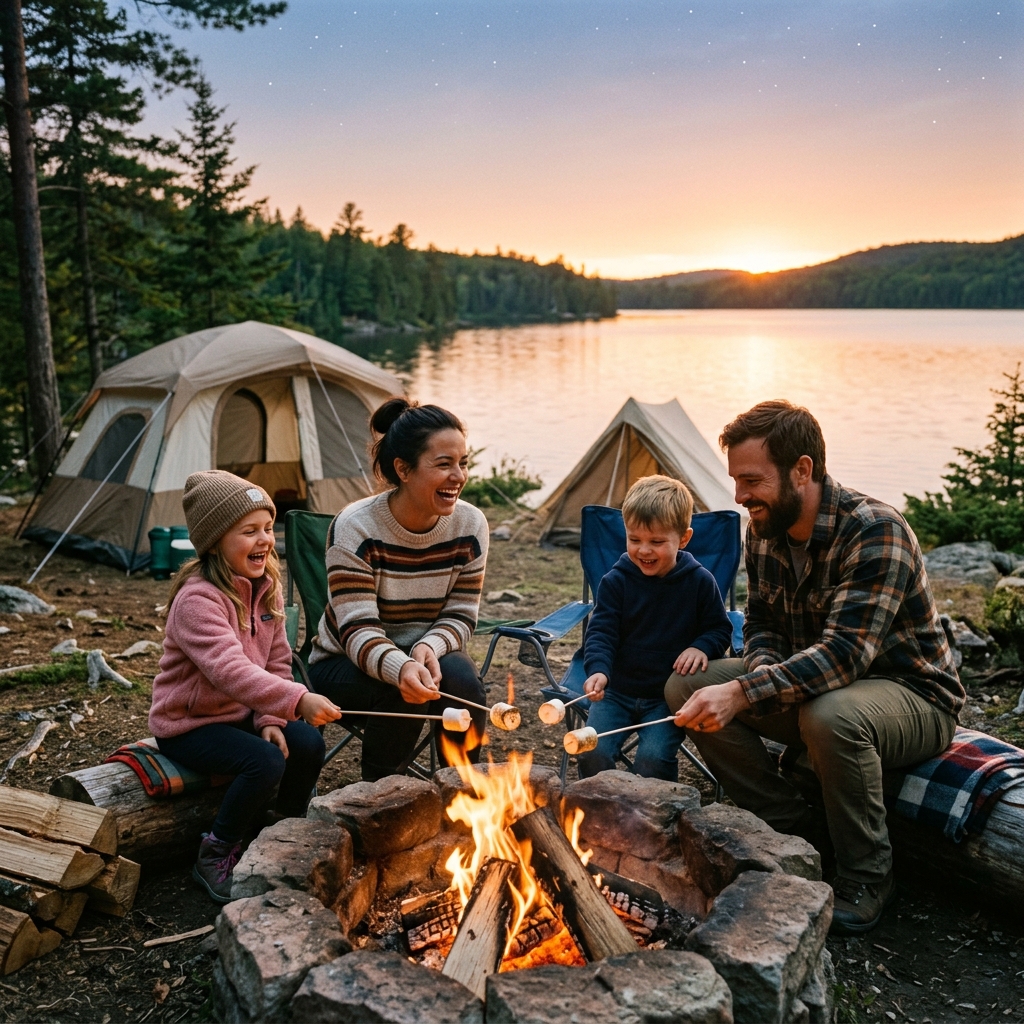
Camping with children is chaotic, slow, occasionally frustrating, and often transcendent. Kids experience the outdoors differently — with more wonder, more noise, and considerably less patience for the parts that aren't immediately interesting.
This guide is written for parents doing everything from a first family campout to a multi-night trip with kids of different ages. The principles are the same regardless of age: lower the logistical bar, raise the engagement bar, and accept that it will not go as planned.
Setting Expectations: Family Camping is Different
The mental shift that makes family camping work is this: the goal is not a clean outdoor experience. The goal is a shared experience that creates memories and builds an ongoing relationship with the outdoors.
That means:
- Slower everything — setup, hikes, meals, bedtime
- Different success metrics — "nobody cried after 8pm" is a win
- Flexibility over planning — be ready to abandon the agenda
- Role-modeling matters more than outcomes — how you respond to the rain/the spilled pot/the forgotten stakes teaches as much as the trip itself
Age-Appropriate Expectations
Toddlers (1–3 years)
The trip is primarily for the parents, not the toddler. Toddlers will have fun as long as they're safe, fed, and close to a parent. Keep trips short (one night), close to home, and at campgrounds with bathroom facilities.
Plan activities that work at toddler pace: collecting rocks, playing in dirt near camp, watching the fire from a safe distance, short walks (not hikes). Don't expect a toddler to appreciate the scenery. They're interested in the immediate and tactile.
Sleep is the central challenge. Toddlers don't transfer easily to a new sleep environment. Bring familiar items (stuffed animal, sleep sack). Accept that the first night may be rough.
Elementary Age (6–11 years)
The sweet spot for family camping. Kids this age are old enough to be genuinely useful at camp, curious about the natural world, and capable of 2–5 mile hikes without constant carrying. They're also still enthusiastic enough that they haven't decided outdoors is uncool.
Let them have roles: fire tender (with supervision), cook assistant, map navigator, wildlife spotter. Agency and responsibility dramatically increase engagement.
This is the age to introduce:
- Basic navigation (how to read a trail map, what the blazes mean)
- Leave No Trace principles
- Simple wilderness skills (how to build a fire, tie a knot, identify a few trees or birds)
Teenagers (12–17 years)
Some teenagers arrive at family camping trips already engaged. Others need to be brought in deliberately. The strategies are different:
Don't assume they're interested, but don't assume they're not. Many teens are privately excited and publicly indifferent.
Give them control over something meaningful: their own route choice, what's for dinner, when to break camp. Remove the sense that everything is being done at them.
Bring a friend when possible. The social dynamic matters enormously at this age.
Physical challenge often works — a technically demanding hike, a long day, summiting something. Teens often respond to being genuinely pushed.
Choosing the Right Campsite for Families
Facilities matter more with kids. Flush toilets make nights dramatically easier with young children. Camp showers reduce multi-day friction significantly. Look for campgrounds with:
- Flush toilets within reasonable walking distance of your site
- Potable water at or near the site
- Playgrounds or beach access if available
- Cell service (for the parents)
Site selection within the campground:
- Choose a site with shade for afternoon heat
- Corner sites or end-of-loop sites have fewer neighbors and more space to spread out
- Look for a site with natural play features: rocks, logs, a small stream — these entertain kids for hours with no effort
Distance from trailheads: Calculate hike distances at a children's pace, not an adult's. A 5-year-old hikes roughly 1–1.5 miles per hour on flat terrain, less on elevation. Multiply your expected time to trail by 1.5–2x.
Gear Adjustments for Family Camping
Tents: Size up significantly. A "4-person" tent comfortably sleeps a family of three. A family of four with gear needs a 6-person tent. Consider a vestibule — it becomes storage for muddy boots, strollers, and everything else that doesn't fit inside.
Sleeping: Kids generally sleep cold. Bring a sleeping bag rated 10–15°F colder than the forecasted low, and a liner for the youngest children. Sleeping pads are important even for small children — the ground is cold regardless of age.
Clothing: Bring twice as many socks as you think you need for kids. Kids go through socks. Pack a complete extra set of clothes for each child in a labeled dry bag for the inevitable full-body mud situation.
Lighting: Give each child their own headlamp. This is one of the most effective ways to get kids invested in the trip. Let them pick it out in advance if possible.
Keeping Kids Engaged at Camp
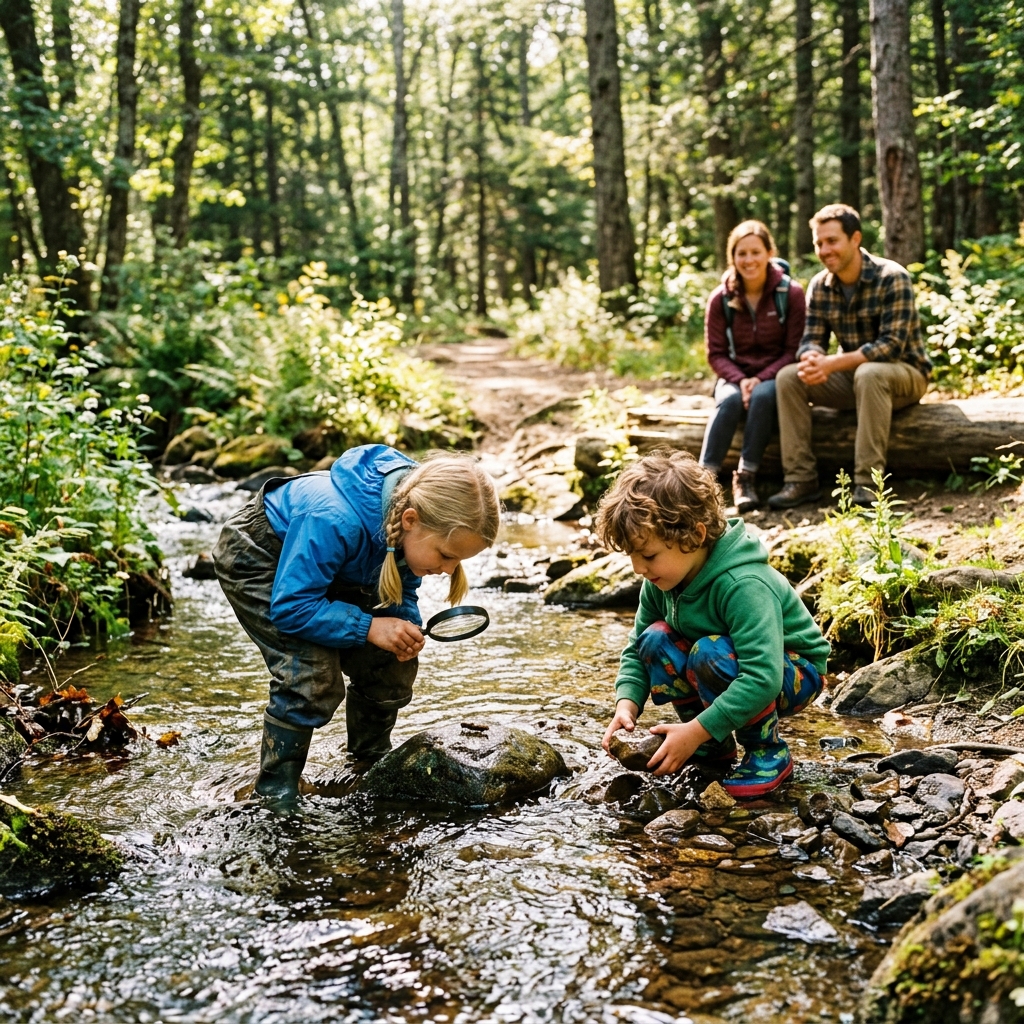 A stream, a magnifying glass, and two hours of self-directed exploration. The gear store has nothing on this.
Nature-specific activities that work:
The Sit Spot: Have kids choose one spot near camp and sit quietly for 5–10 minutes, recording everything they notice. Makes children more observant and teaches stillness in a nature context.
Scavenger hunts: Create a list appropriate to your environment (pinecone, spider web, something red, something smooth). Kids of all ages engage with this.
Identification guides: A regional bird or tree guide from a ranger station gives kids something to do while walking slowly. iNaturalist (free app) is excellent for this — kids photograph things and get real identifications.
Night sky: Children are often genuinely astonished by a dark sky with no light pollution. Bring a red-light headlamp (preserves night vision) and a simple star map. The Stellarium app is free and works offline.
Fire making: With appropriate supervision, elementary-age and older kids love being trusted with fire tasks. Gathering kindling, building the fire structure, learning to use a lighter safely.
Rainy day activities:
- Card games in the tent
- Journaling or drawing
- Cooking elaborate meals when you're stuck at camp anyway
- Listening to rain on the tent fly (this is genuinely enjoyable for most children)
Meals: The Most Impactful Logistics Decision
Food makes or breaks family camping morale. Hungry, cold kids become miserable kids fast.
Snack aggressively. Far more than you think necessary. Pack trail mix, bars, fruit, crackers, cheese, and jerky in accessible locations. Keep snacks flowing between meals. Kids' caloric needs spike with activity and cold.
Involve kids in cooking. Stirring oatmeal, adding ingredients, using the spork to mash potatoes — participation makes food more interesting and teaches skills.
Simple dinners first. For the first trip, keep dinner to: boil water → add to pouch, or one-pot pasta with a sauce packet. Elaborate meals require practice under non-stressful conditions. Add complexity on subsequent trips.
Make breakfast a ritual. Camp pancakes, scrambled eggs cooked in a titanium pan, hot chocolate. A special breakfast signals that camp cooking is different from home cooking in a good way.
Bedtime: The Critical Hour
This is where family camping trips succeed or fail.
Establish the bedtime routine early. Kids (especially younger ones) need the routine cues that signal sleep is coming. Replicate as much of the home routine as possible: teeth brushing, a book, the same stuffed animal.
Have a dedicated headlamp or lantern for the tent. Kids who have a light of their own are less anxious about tent darkness.
Start earlier than you think. Camp bedtime for young children is 7:30–8pm, not whenever the parents are tired. A child who blows past their sleep window in a stimulating environment often struggles to fall asleep for hours. Get ahead of it.
Accept that night one will fight you. New environment, new sounds, excitement, no blackout curtains. Night one is almost always harder than nights two and three. Don't let night one's difficulty make you write off the whole trip.
Leave No Trace with Children
Teaching Leave No Trace to children is one of the most lasting gifts of family camping. Kids who learn these ethics early carry them forever.
At appropriate ages, explain the why: wildlife needs to find their own food, not ours; plants that get stepped on die; trash takes decades to break down. Kids respond well to honest explanations.
Practice: pack out more than you packed in (pick up one piece of trail trash per hike). Make it a contribution, not a rule.
Family Camping First Trip Checklist
High-priority additions for families:
- Complete extra clothing set per child (labeled dry bag)
- Child-specific headlamp (let them pick it)
- Familiar bedtime items (stuffed animal, book, sleep cues)
- Significantly more snacks than you think you need
- Children's first aid additions: Children's Benadryl, liquid Tylenol, instant cold pack, moleskin for small blisters
- Baby wipes (multiple packs)
- Change of clothes for all adults too (kids perform miracles of mess-distribution)
- Nature identification guide or iNaturalist app downloaded
- Cards or small camp games for downtime
The families that camp successfully year after year are not the ones with perfect logistics. They're the ones who lower their expectations for any individual trip and hold high expectations for the cumulative experience over many trips.
Your kids will remember almost nothing about the weather or the food. They'll remember the thing they found in the stream, the way the fire smelled, the morning you all slept in and made pancakes. Those moments don't require perfect conditions. They require showing up.