

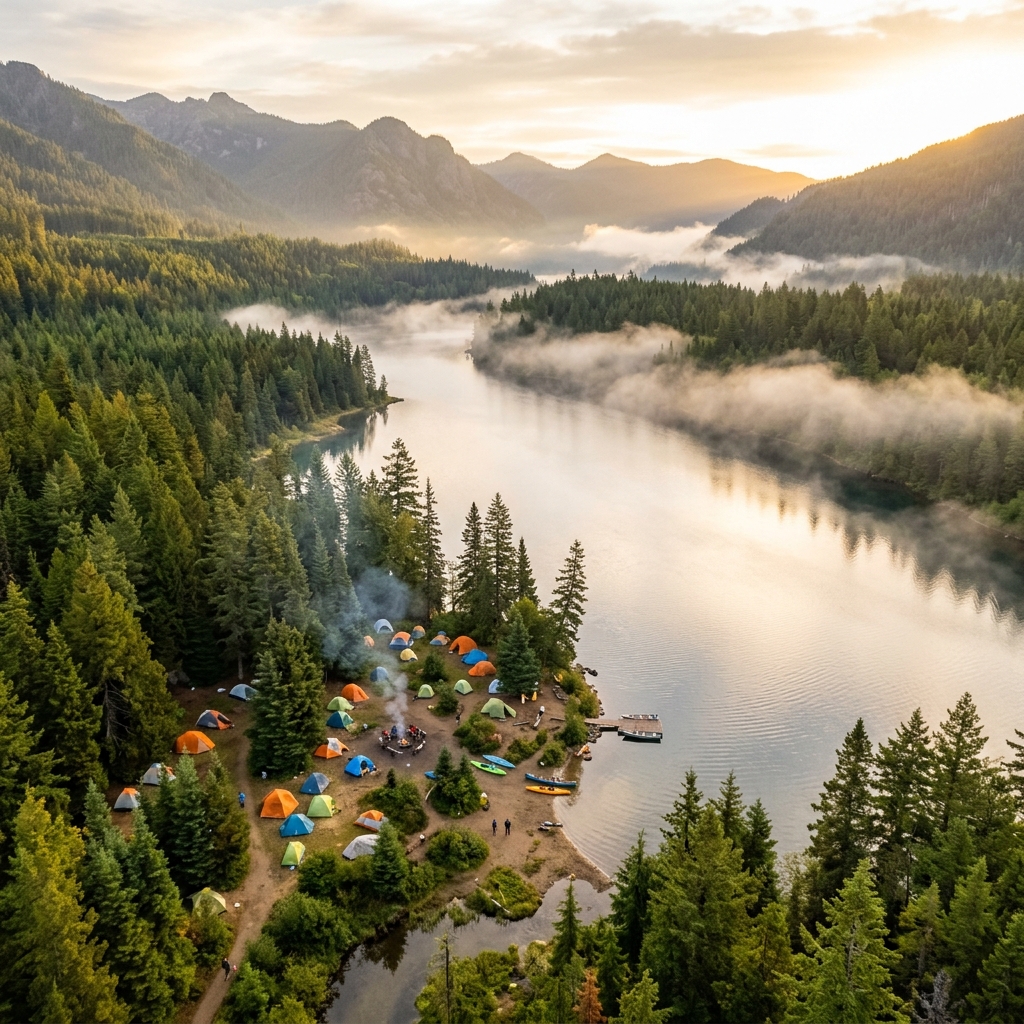
Water is the most critical resource in the outdoors. You can camp with minimal food for days, but dehydration becomes a medical problem in hours. Understanding where to get water, how to make it safe, and how much you need is fundamental outdoor knowledge.
The Threat: What's Actually in Natural Water
Natural water sources — even those that look clear and fast-moving — can contain:
Protozoa: Giardia lamblia and Cryptosporidium parvum. These are the most common concerns in North American water. Both cause significant gastrointestinal illness (nausea, diarrhea, cramping) that typically appears 1–3 weeks after exposure. Giardia is extremely prevalent in backcountry water.
Bacteria: E. coli, Salmonella, Leptospira. Risk increases downstream from human activity, livestock grazing, and in warm temperatures.
Viruses: Norovirus, Hepatitis A, Rotavirus. Risk is low in remote North American wilderness but significant in international trekking destinations and areas with human contamination.
Chemical contamination: Near mining operations, agricultural runoff, or industrial areas. No portable filter addresses chemical contamination — avoid these sources entirely.
The appearance of water tells you almost nothing about its safety. Clear, cold mountain streams can carry Giardia cysts. The cysts are microscopic.
The Four Methods: How They Work and When to Use Them
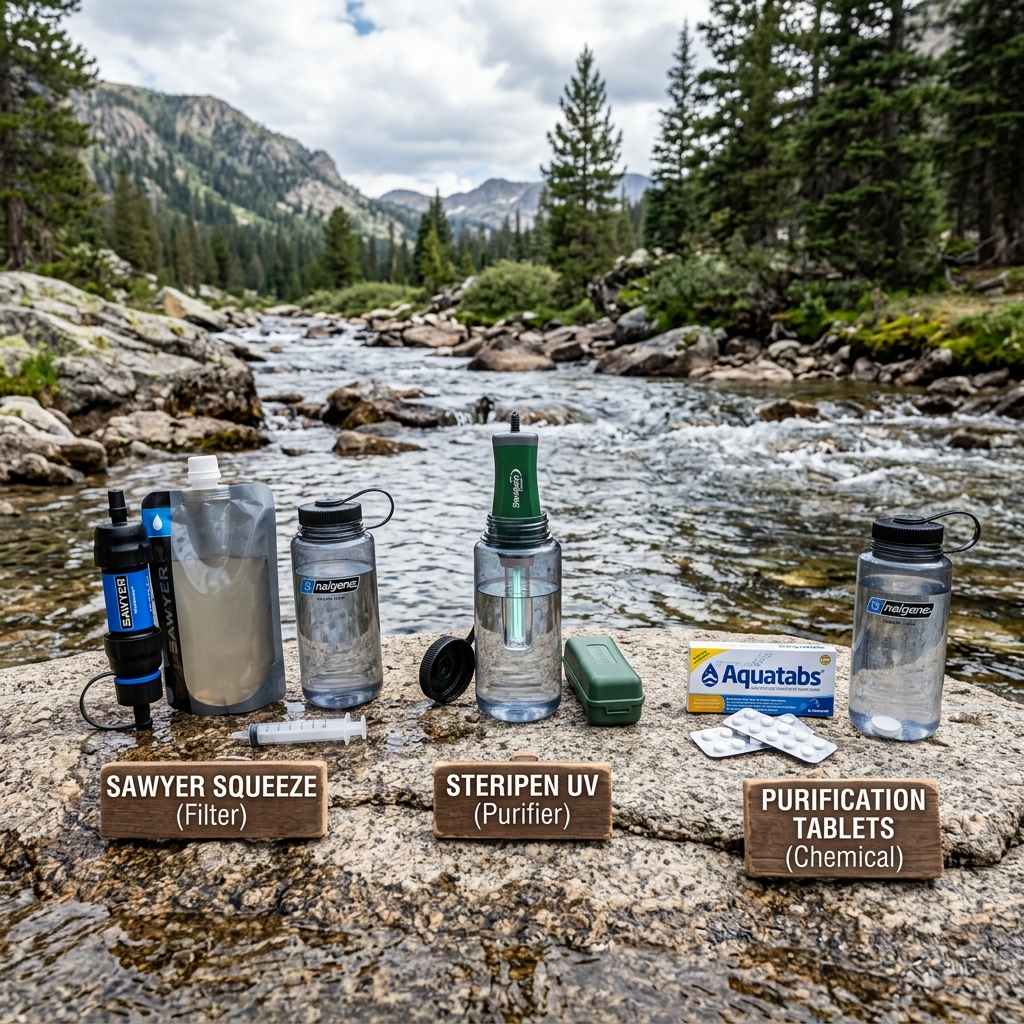 Left to right: filter straw (Sawyer Squeeze), UV purifier (Steripen), and chemical tablets. Each addresses different threat profiles.
1. Mechanical Filtration
How it works: Water is forced through a hollow fiber membrane with pores small enough to block protozoa and bacteria. The most common and practical method for North American wilderness.
What it removes: Protozoa (Giardia, Cryptosporidium), bacteria. What it does NOT remove: Viruses, chemical contamination.
Top filters:
| Filter | Weight | Flow Rate | Notes |
|---|---|---|---|
| Sawyer Squeeze | 3 oz | Moderate | Best value; rated to 100,000 gal |
| Sawyer Mini | 1.4 oz | Slow | Ultralight; works but slow for group use |
| MSR TrailShot | 2.8 oz | Fast | Convenient squeeze + direct drink design |
| Katadyn BeFree | 2.3 oz | Fast | Excellent flow rate; soft flask included |
| MSR Guardian | 17 oz | Very fast | Removes viruses; heavy; for international use |
Sawyer Squeeze usage: Fill a squeeze bag or standard-mouth water bottle with source water, screw on the Sawyer filter, and squeeze through into your drinking vessel. Backflush with the plunger after every trip to maintain flow rate, and before long-term storage. Never freeze a Sawyer filter — the membrane cracks and the filter is rendered unsafe. Check the plunger is included when purchasing.
Filter maintenance: Hollow fiber filters clog over time with particulate. Backflush regularly. Do not use in water with high sediment without first pre-filtering through a bandana or coffee filter.
2. UV Purification
How it works: Ultraviolet light damages the DNA of microorganisms, rendering them unable to reproduce. Effective against protozoa, bacteria, AND viruses.
What it removes: Protozoa, bacteria, viruses. What it does NOT remove: Chemical contamination. Requires clear water — turbid or cloudy water blocks UV penetration and allows pathogens to survive.
Primary option: Steripen Ultra, Steripen Adventurer. Battery-powered (rechargeable USB via Steripen Ultra) or CR123 batteries. Purifies 1L in about 90 seconds.
Limitations:
- Requires batteries — failure point in extended trips
- Does not work in turbid water (filter first)
- More expensive than chemical tabs
- Not as intuitive for newer users
Best use: International travel, trips where viral contamination is a concern, as a complement to filtration in uncertain water quality situations.
3. Chemical Purification
How it works: Chemical agents kill or inactivate microorganisms when left in contact for sufficient time.
Options:
Aquatabs (Sodium Dichloroisocyanurate): The international standard purification tablet. Effective against bacteria and viruses. Variable effectiveness against Giardia; less effective against Cryptosporidium.
Iodine tablets: Effective against bacteria and viruses; less effective against Cryptosporidium. Not recommended for pregnant women or those with thyroid conditions. Leaves a distinctive taste.
Chlorine dioxide tablets (Potable Aqua, Katadyn Micropur): The most effective chemical option — kills bacteria, viruses, Giardia, AND Cryptosporidium with extended contact time (4 hours for Cryptosporidium). Minimal taste impact compared to iodine.
Contact time matters: Chlorine dioxide takes 30 minutes for bacteria and viruses, and up to 4 hours for Cryptosporidium in cold water. Don't shortcut the wait.
Best use: Emergency backup (ultralight, essentially weightless), international travel, when a filter is unavailable.
4. Boiling
How it works: Heat denatures proteins and kills all biological threats.
Effective against: All pathogens — protozoa, bacteria, viruses, even some chemicals are partially neutralized.
How long to boil: At sea level, a full rolling boil for 1 minute. At elevations above 6,500 feet, boil for 3 minutes (water boils at a lower temperature at altitude, requiring longer to achieve equivalent sterilization effect).
Limitation: Fuel-intensive. Not practical as a primary water treatment strategy for multi-day trips with limited fuel. Excellent as an emergency backup when filters aren't available.
Choosing the Right Method for Your Trip
| Situation | Recommended Method |
|---|---|
| Weekend backpacking in US/Canada | Sawyer Squeeze or filter of choice |
| International backcountry travel | Filter + UV or filter + chlorine dioxide |
| Car camping (uncertain tap quality) | Iodine or Aquatabs as backup |
| Emergency backup (ultralight) | Chlorine dioxide tablets |
| Basecamp cooking (can boil) | Boiling + chemical for drinking water |
For most North American wilderness camping: mechanical filtration is sufficient. The Sawyer Squeeze is the best combination of cost, weight, effectiveness, and longevity.
Water Sources: Selection Matters
Best sources:
- Clear, fast-moving streams above any human activity
- Springs (water emerging directly from the ground — the most reliably clean surface water)
- Snow melt (filter or treat for bacteria introduced by animals)
Avoid:
- Downstream from populated areas, agricultural land, or livestock grazing
- Still, warm ponds or slow-moving water (bacterial growth is higher)
- Visibly silty or discolored water (sediment clogs filters; turbidity prevents UV effectiveness)
- Downstream from dead animals
Collection technique: Fill containers from the swiftest, cleanest section of a stream. Keep the mouth of the container pointed upstream. Avoid disturbing bottom sediment.
Hydration: How Much You Actually Need
Dehydration is consistently underappreciated as a factor in trail accidents and poor camp decision-making. Mild dehydration (1–2% body weight in fluid loss) measurably impairs physical and cognitive performance.
General guidelines:
- At rest in mild conditions: 2 liters per day minimum
- During moderate hiking: 0.5 liters per hour
- In heat or at altitude: 1+ liter per hour
- Children: Roughly 1.5–2 liters per day, more with activity
Indicators:
- Pale yellow urine: Well-hydrated
- Dark yellow or orange urine: Dehydrated — drink now
- Colorless urine with frequent urination: Over-drinking — add electrolytes
Electrolytes: Drinking only water during sustained high-exertion activity can dilute sodium to dangerous levels (hyponatremia). In heat or during multi-hour output, use electrolyte packets (Nuun, Liquid IV, Scratch Labs) rather than plain water. Sports drinks work but are heavier to carry.
Carry capacity: 2 liters minimum in your carry system (hydration bladder or bottles). On exposed routes or in heat, 3–4 liters. On routes with reliable water sources every 1–2 hours, 1–1.5 liters between fills is sufficient.
At Developed Campgrounds
Developed campgrounds with potable water spigots generally provide municipal or well water tested to EPA standards. You do not need to filter potable water from campground sources.
If the water smells strongly of chlorine: normal municipal treatment, safe to drink. If the water is discolored or has unusual taste or odor beyond chlorine: ask camp staff or use filtration.
Some dispersed-camping adjacent water sources near campground roads are NOT the same as the potable campground water. Don't assume a tap or spigot is potable — look for "potable water" signage.
Clean water is the foundation of every camping trip. A quality filter weighs 3 ounces, costs $35, and lasts 15+ years. It is the highest-return single investment a new camper can make.