

These aren't "put a marshmallow on the end of a fork" tips. These are the practical, field-tested pieces of knowledge that experienced campers accumulate over many trips — the things that make camp life measurably better.
Setup & Organization
1. Practice your tent setup at home before every trip. The least exciting but most impactful prep step. Setting up in daylight in your yard confirms you have all the parts, that you remember how it goes, and that stakes and guylines are in the stuff sack. Do this before every trip, not just the first.
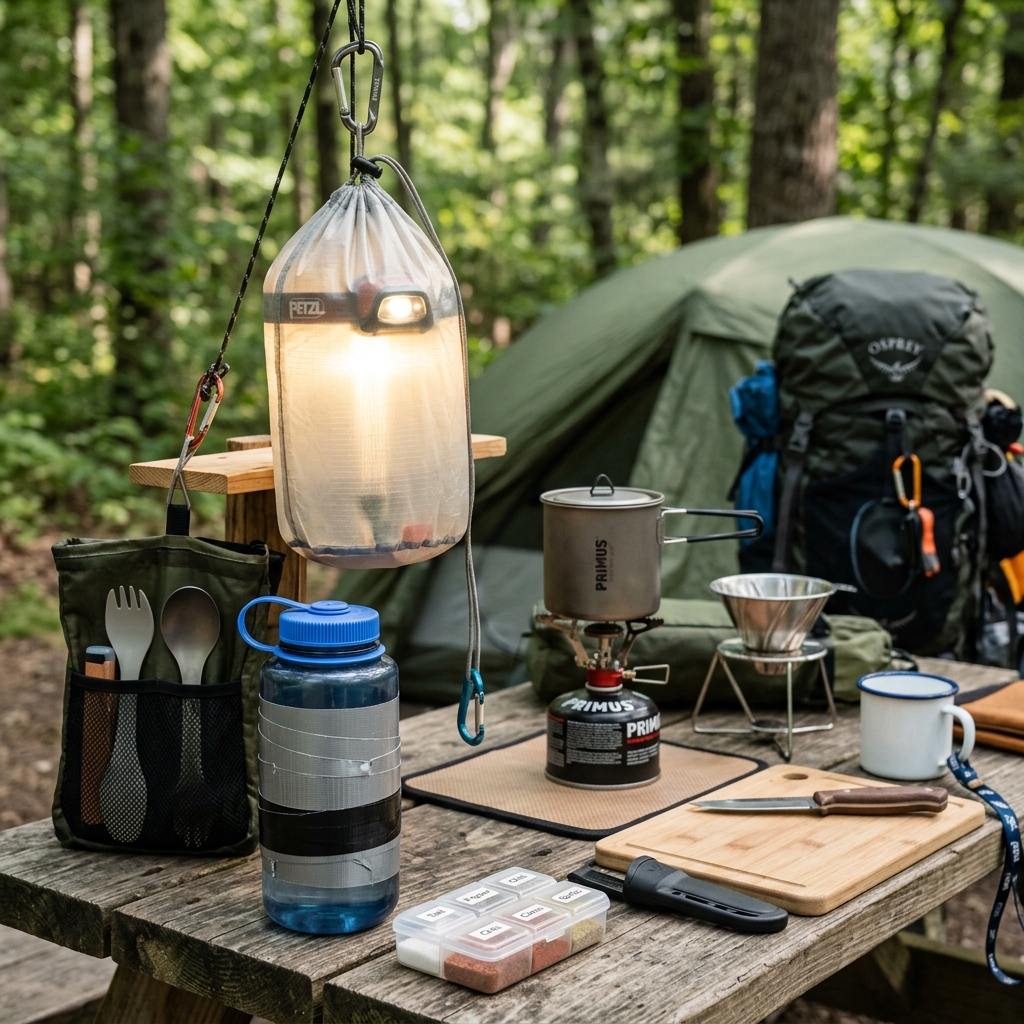
2. Wrap duct tape around your water bottle. Don't bring the full roll. Wrap 10–15 feet of duct tape around a Nalgene or water bottle. You'll use it for gear repair, blister padding, tent seam emergency patches, and things you haven't anticipated yet. Takes ten seconds to wrap and weighs nothing.
3. Label everything in a stuff sack with a marker. When unloading the car at camp in fading light, "kitchen," "sleep," and "clothing" labels eliminate the gear archaeology session. Takes two minutes at home.
4. Use a carabiner to clip the lantern to the tent's center loop. Most tents have a small loop at the ceiling peak designed for exactly this — but many people never discover it. A small headlamp or camp lantern hung here illuminates the whole tent interior for reading and evening activities without requiring anyone to hold it.
5. Set up your sleeping area last. The bedding and sleeping gear stay rolled and packaged until everything else is set up. This keeps it clean and dry while you work on the kitchen and tarps.
6. Use a $5 plastic bin as your campsite recycling/trash system. At developed campgrounds, a small collapsible plastic tub at the edge of the site creates a designated trash collection point that keeps the site clean and prevents wind-blown waste. It also signals to neighbors that you're managing your space.
Sleep
7. Put tomorrow's camp clothes in the foot of your sleeping bag. You'll put on warm clothes in the morning rather than cold clothes. Small thing. Noticeably better.
8. Sleep north-south. Your body retains heat better aligned with the Earth's magnetic field, according to some research — but more practically, north-south alignment on a slight slope puts your head uphill, which is the comfortable direction.
9. Eat a light snack before bed on cold nights. Your metabolism generates heat digesting food. A small, calorie-dense snack (nut butter, cheese, small piece of chocolate) before sleeping on cold nights raises your core temperature enough to notice.
10. Use a hot water bottle at the foot of the bag. Boil water, fill a hard-sided bottle rated for hot water (Nalgene bottles are rated for boiling water — standard water bottles often are not), seal it, and place at the foot of your sleeping bag before you get in. The heat dissipates slowly enough to warm the whole bag and your cold feet significantly.
11. Bend knees when sleeping cold to conserve heat. Sleeping in fetal position rather than stretched flat reduces body surface area and retains heat. The position that feels instinctively warm when cold is physiologically correct.
Cooking & Food
12. Pre-fill zip-lock bags with individual meals before leaving home. Each dinner in its own labeled bag (Dinner 1: pasta, Dinner 2: ramen, etc.) with all needed dry ingredients measured and packed together. At camp, you open one bag rather than measuring and finding ingredients spread through multiple bags. Takes 20 minutes at home; saves significant time and frustration at camp.
13. Use a single spice container. A small, round, airtight 4-compartment spice container holds salt, pepper, garlic powder, and chili flakes — the four spices that improve nearly every camp meal. Available at camping stores or outdoor retailers. Far more practical than bringing individual containers.
14. Coffee filters strain cold water for sediment before filtering. If you're drawing from a silty or murky water source, pre-filter through a bandana or coffee filter before running through your water filter. This extends filter life significantly and prevents clogging.
15. Freeze meat in a solid block before adding to the cooler. Partially frozen meat acts as additional ice for the first 24–36 hours and stays at safe temperature longer than unfrozen meat. Chill the cooler ahead of time as well — an unchilled cooler melts ice dramatically faster.
16. Bring a silicone lid that fits multiple pots. A single silicone pot lid that fits multiple cookware sizes reduces boiling time by 30–40% and keeps heat in during simmering. Available for a few dollars, weighs almost nothing.
17. Make coffee packets at home. Pre-measure ground coffee into small paper filters, twist and tie with a twist tie or rubber band. Drop the packet into your mug, pour boiling water over, wait 4 minutes, remove packet. Essentially French press coffee with no equipment. The grounds stay in the filter and you have clean camp coffee.
Water
18. Backflush your Sawyer filter every single time. The most commonly skipped Sawyer maintenance step. After every use, fill the provided plunger syringe with clean water, attach to the drinking end of the filter, and push water back through. This dislodges sediment and maintains flow rate. Sawyers that are backflushed perform better for their entire rated lifespan of 100,000 gallons.
19. Mark water capacity on your Nalgene with a paint pen. Lines at 250ml, 500ml, 750ml, and 1L make it easy to track exactly how much you've consumed or how much needs treating. Useful for mixing electrolytes at the right concentration too.
Comfort & Style
20. Bring a real pillow for car camping. The compressible camp pillow is a perfectly useful backpacking compromise. For car camping, it's completely unnecessary — bring the cheap flat pillow from home. More comfortable, already familiar, free.
21. A mesh hanging organizer in the tent changes everything. A small hanging mesh organizer (designed for camping, or repurposed from an over-door organizer) attached to the tent's center pole keeps headlamp, glasses, lip balm, phone, and ear plugs within reach without leaving the bag. No more 3am floor excavation.
22. Keep a dedicated "door shoes" hook or clip at the tent entrance. A carabiner clipped to the outside of the tent zipper pull or vestibule pole becomes the shoe hook. Shoes always in the same place, always accessible, always outside the sleeping area.
Hygiene & Leave No Trace
23. A small spray bottle of isopropyl alcohol for camp dishes. After washing and rinsing camp dishes, a spray of isopropyl alcohol (70%) and a quick dry functions as a sanitizing step without requiring hot water for every wash. Weighs almost nothing, adds real hygiene value.
24. Pack out orange peels and banana peels. The Leave No Trace rule is "pack out all food scraps" — this includes fruit peels, which commonly take 6 months to 2 years to break down depending on climate. They also attract wildlife. They go in your trash bag, not thrown into the trees.
25. Cat hole pre-scouting before dark. If you're in an area without toilets, identify and pre-dig your cat holes while there's still light. The 200-foot distance from water, trails, and camp is much easier to measure in daylight. Pre-placed, they're available immediately at 3am without navigation or excavation in the dark.
The Meta-Hack
The most consistently useful camping hack is deceptively simple: keep a running notes list after every trip. What did you wish you'd had? What did you bring and never use? What setup step took too long? What tasted better than expected?
After 3–4 trips building this list, your personal camping system is calibrated to what you actually do, not what the gear stores think you should need. That's the foundation of good camping — every trip teaching the next one.